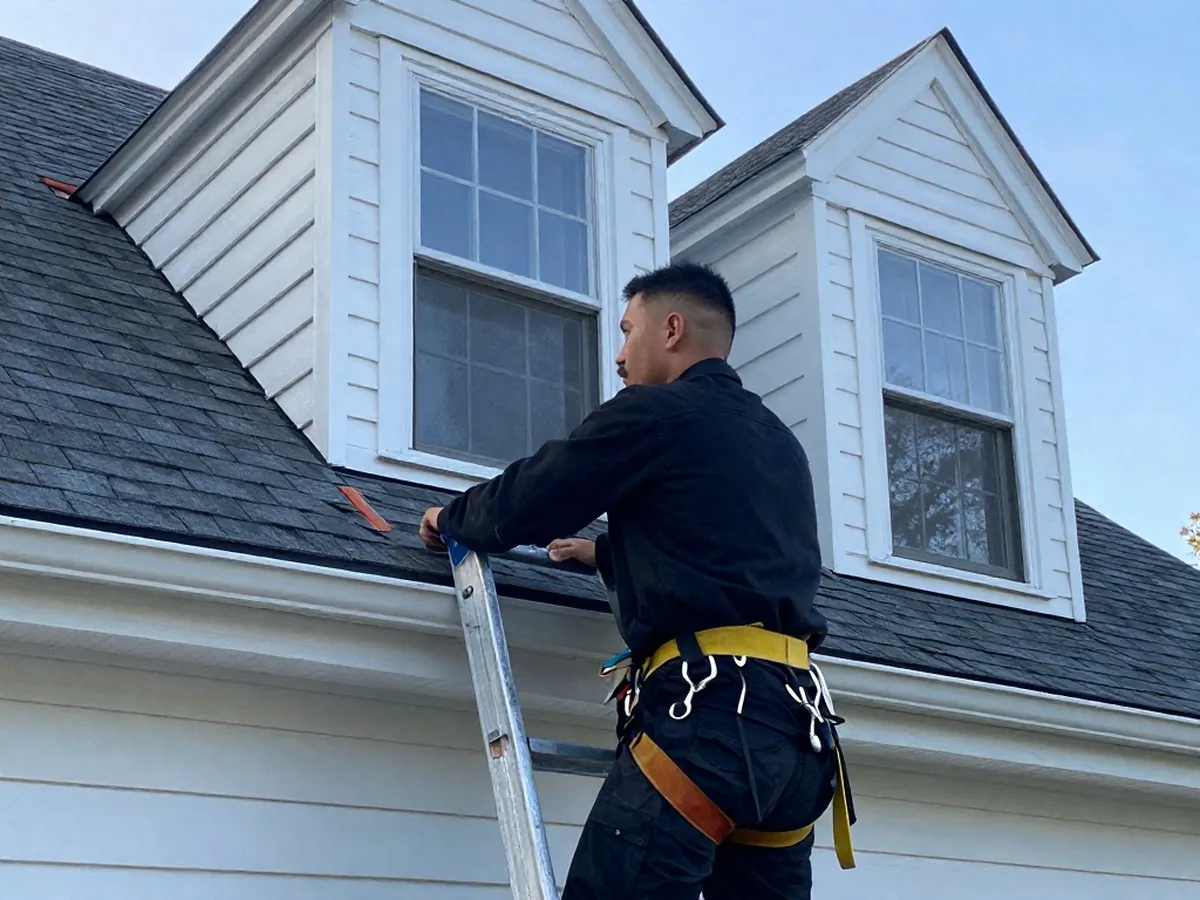
January and February: snow, thaw and the attic
Newark's normals for January are a high of 40 degrees and a low of 25.5, with 9.1 inches of snow. February averages 43 and 27.2, with 10.1 inches. The 2026 winter went well past that: 11.7 inches at Newark Airport on January 25-26, then 27.2 on February 22-23, when the National Weather Service said blizzard criteria were met in Union County.
The UMass Amherst building-science article says an ice dam takes three things: snow on the roof, warmth from below to melt it, and cold at the eave to refreeze the water. Heat leaking up from the living space is the cause, the article adds. Look at the eave from the ground, look for stains on top-floor ceilings after a thaw, and leave the chipping alone.
March and April: the first look after winter
March brings 4.13 inches of rain and 5.6 of snow on Newark's normals. April drops to 3.87 inches of rain and half an inch of snow, a gentle month for a roof to be inspected. The Asphalt Roofing Manufacturers Association's low-slope guidance asks for a professional inspection each spring and fall.
From the yard, look for missing or loose shingles, flashing standing off a wall and clogged gutters. The Building America flashing guide says peeling paint or staining on wood siding beside a roof can show water entry early, while vinyl, fiber cement and brick can hide it for years.
May and June: limbs, drains and joints
Spring growth is a chance to trim limbs that hang over the roof, which ARMA lists as an owner task along with clearing debris from drains and gutters. ARMA also notes that a roof is not built for much foot traffic, so leave the clearing to a roofer or do it from stable ground.
The National Park Service advises looking yearly for gaps, cracks or missing flashing at chimneys and walls. A photograph taken now makes a before-and-after record for the storm season ahead.
July and August: thunderstorms and the heat record
Newark's July normals are a high of 86.9 degrees, a low of 69.4 and 4.66 inches of rain, and the almanac's highest July reading is 108 degrees on July 22, 2011. Storms matter more than temperature for a shingle roof. On July 3, 2026, the National Weather Service logged gusts of 71 mph at Newark Airport and 58 mph at Linden Airport, with trees falling onto a house in Linden.
After a storm, begin at ground level or at an upstairs window with binoculars, which is ARMA's advice, and photograph anything you see before cleanup.
September and October: Ida's lesson and the leaf drop
September's normal at Newark is 3.82 inches of rain, yet the station's monthly record is 10.5 inches, set in 2021 when Ida's remnants left 8.44 inches at Newark Airport over September 1 and 2, 3.65 of them in a single hour. October's normal is 3.79 inches.
That is the time to clear gutters and check where each downspout lands. The EPA's Soak Up the Rain page points to lawns, gardens and rain barrels, and cautions that some downspouts connect to buried pipes that lead to a sewer or storm drain.
November and December: the last look before winter
December's normals at Newark are a high of 44.8 degrees, a low of 31.2, 5.4 inches of snow and 4.14 inches of precipitation overall. It is the last easy month to look at the attic for gaps around pipes and hatches, to check the gutters one more time and to photograph the roof for the record.
Keep ladders ten feet from power lines, as NIOSH advises, and treat any downed wire as live, as PSE&G does. Ice-loaded limbs can bring wires down. PSE&G's line for that is 1-800-436-7734, and 911 is there if someone is hurt.
Twelve months on one roof
- January
- look at the eave and top-floor ceilings after a thaw.
- February
- note where snow stays and where ice forms.
- March
- first walk-around from the yard, gutters and flashing.
- April
- spring inspection by a roofer if the roof is older.
- May
- trim limbs that overhang the roof.
- June
- photograph each slope for the record.
- July
- after thunderstorms, check from the ground.
- August
- look at downspouts and the places where water lands.
- September
- heavy-rain check of ceilings and the foundation edge.
- October
- clear gutters and drains.
- November
- attic check for gaps and hatches.
- December
- last look, and the roofer's number saved on the phone.
Seen something on the calendar that fits your roof?
Match the month to the sign, then follow the link. Ice dam damage covers winter, storm damage repair covers the summer thunderstorms. Call (732) 487-3991 and describe the sign you matched.